Same Savings, Half the Thresholds: MFJ to Single, RMDs, and IRMAA
When one spouse dies, the survivor's Medicare income thresholds are cut in half while RMDs keep growing. A year-by-year worked example of the widow's penalty.

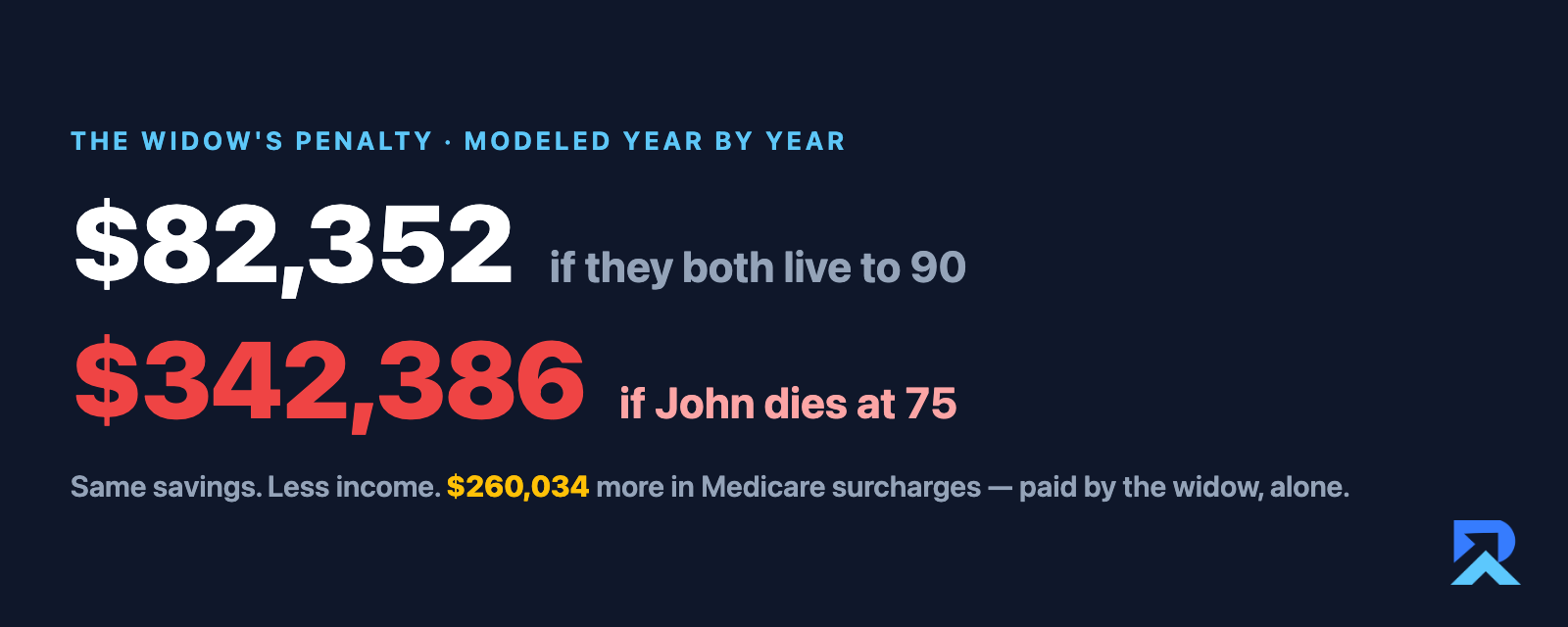
The widow’s penalty is what happens when a household’s income barely changes but its tax treatment does. We modeled one couple year by year in RetirementAdvisorPro, twice — same savings, same withdrawals, same claiming decisions; the only input that changes is one date of death. If John and Jane both live to 90, they pay $82,352 of lifetime IRMAA surcharges — two people, and nothing at all until age 87. If John dies at 75, Jane pays $342,386 by herself: more than 4× as much, on less income. The gap — $260,034 — is the widow’s penalty, priced.
The bill comes from one legal fact: the year after a spouse dies, most retired survivors file as Single, and the IRMAA thresholds for a single filer are half the married amounts ($109,000 versus $218,000 of MAGI in 2026, per CMS). Meanwhile the income barely moves: the survivor keeps the larger Social Security check, inherits the retirement accounts, and the withdrawals and required distributions keep coming either way.
Three rule changes hit a surviving spouse at once. Filing status: the survivor may file jointly in the year of death, but the qualifying-surviving-spouse status that extends joint rates for two more years requires a dependent child at home, per IRS Publication 501 — so for nearly every retired widow, Single status begins the following January. Tax brackets and the standard deduction compress to roughly half their married width. And Medicare’s income-related surcharge uses threshold tables where the Single column is cut in half at every tier this household would ever touch ($109,000 versus $218,000 at the first line; only the top tier, $500,000 versus $750,000, breaks the pattern).
The income side falls much more gently. Under Social Security’s survivor rules the widow generally keeps the higher of the two benefits — in our scenario Jane’s own small check is replaced by John’s much larger one, so the household loses only the smaller check. The 401(k)s pass to her by spousal rollover, and the withdrawals and required distributions continue on one return. A household that kept most of its income now reports it against thresholds that shrank by 50%. That asymmetry is the entire penalty.
John and Jane were both born in November 1970 — 55 in 2026. Jane works to 65 earning $3,400 a month; both retire and enroll in Medicare at 65. John’s Social Security is $4,000 a month at his full retirement age of 67; Jane’s is $1,000 at FRA, claimed early at 65 and reduced to $866.67. They hold $900,000 in pre-tax retirement accounts — John’s $600,000 401(k) paying out $2,500 a month from 65, a $100,000 brokerage retirement account paying $1,000 a month, and Jane’s $200,000 401(k), untouched — plus $562,000 in Roth accounts, whose withdrawals never appear in MAGI. This is a deliberately unadvised baseline: real withdrawals for real living expenses, but no Roth conversions, no IRMAA-aware sizing, benefits claimed without a strategy. At 75 — born after 1960, so SECURE 2.0’s latest start age applies — required minimum distributions begin stacking on top of the withdrawals, and taxable income climbs for the rest of both projections.
Assumptions behind the model
Both spouses born November 1970; retirement and Medicare enrollment at 65. Social Security: his $4,000/month at FRA 67; hers $1,000/month at FRA, claimed at 65 ($866.67 after the early-claiming reduction); 2% COLA; survivor takes the higher benefit. Her wages $3,400/month until 65. Pre-tax accounts $900,000 total (his 401(k) $600,000 with $1,000/month contributions until retirement, withdrawing $2,500/month from 65; a $100,000 brokerage retirement account withdrawing $1,000/month; her $200,000 401(k) untouched); Roth accounts $562,000, withdrawals excluded from MAGI; 7% growth. RMDs from age 75 (SECURE 2.0, born after 1960). Part B premiums inflated 7.3% per year — the 60-year historical average — and Part D 4.1%; IRMAA thresholds indexed 1% per year from the 2026 CMS baseline ($202.90 standard Part B premium; first tier at $218,000 MFJ / $109,000 Single). Lookback filing status follows POMS HI 01101.020: premiums priced from a married-year return use the married table. Surcharge totals are IRMAA only — base premiums and income taxes are excluded. Modeled in RetirementAdvisorPro; the scenario is reproducible in the app from these inputs. Hypothetical illustration for advisor education; not individual tax, investment, or Medicare advice.
Ending one: both live to 90. As joint filers, John and Jane pay no surcharge at all for the first 22 years of the plan. Their MAGI finally crosses the married threshold at 87, and they finish with four tier-1 years — $18,522, $19,835, $21,243, $22,752, split between two people. Lifetime IRMAA: $82,352.
Ending two: John dies at 75, in November 2045. Jane rolls over his 401(k), takes his larger Social Security check, and files Single from 2046 on. Her first surcharge lands at 78 — $5,012 — and never leaves: second tier at 80 ($14,389), third at 85 ($32,380), fourth at 90, where she pays $62,695 in a single year. Her final two years alone — $42,570 plus $62,695, or $105,265 — exceed everything the couple would have paid in a lifetime. (RetirementAdvisorPro models her total at $354,124; we publish $342,386, conservatively excluding her age-77 year — $11,738 — because its lookback return is the 2045 year-of-death joint return, which carries married thresholds under POMS HI 01101.020.)
The cleanest way to see the penalty is the same year, side by side. At 87, the couple’s version of this household pays $18,522 between two people, on $334,000 of MAGI. Jane’s version pays $37,122 — alone, on $283,000. Less income, double the dollars, one person.
Sensitivity: these projections grow the IRMAA thresholds at 1% per year. Index them at full CPI (roughly 2.5%) and the couple’s picture only improves: their highest income year used for a premium (about $347,000) would never reach the married first threshold (about $469,000 by that year), so the couple would pay no surcharges at all — while the surviving spouse, measured against thresholds half the size, would still face surcharges well into her 80s. Slower threshold growth is the conservative choice for the couple; the widow’s penalty is structural either way.
IRMAA prices each year’s premium off MAGI from two years earlier — and, per the regulation behind the tables (20 CFR 418.1115, implemented in POMS HI 01101.020), the threshold table that applies is the one for the filing status on that lookback-year return. That detail protects Jane at first: her premiums through 2047 are priced from returns that include John, so the married table applies and no surcharge lands.
The exposure begins when her first Single return enters the lookback. From 2046 on, the household’s withdrawals, the survivor benefit, and eventually every dollar of RMD income — built up over two lifetimes — land on one Single return, and two years later each of those returns is judged against thresholds half the married size. Her first surcharged premium arrives in 2048, at 78, and once the crossing starts it never reverses: the income grows mechanically every year, and the single-filer tiers keep catching it.
What about the appeal? Death of a spouse is a qualifying life-changing event for Form SSA-44, but the appeal works by substituting the survivor’s current-year income for the lookback year — it only helps when the death cuts income deeply enough to change tiers. Jane’s income does fall when the smaller Social Security check ends, but only slightly: $187,312 of joint-year MAGI becomes $171,282 in her first full year alone — still the same single-filer surcharge tier. The withdrawals continued, the inherited RMDs arrived, and the survivor benefit replaced her smaller check with a larger one. One practical note for advisors: practitioners report cases where SSA bills a new widow’s premium by applying the single table to joint-year income — if that happens, SSA-44 is the remedy, and it works. Our published figure uses the regulation’s reading, which is the conservative one for this story.
Once a spouse has died, the survivor’s options are limited to managing MAGI at the margins. The meaningful planning window is earlier, while the household still has married-filing-jointly rates and two names on the return. Every dollar converted to Roth in that window — sized under the couple’s own IRMAA thresholds — is taxed once at joint rates and never appears in an RMD, a MAGI calculation, or a surcharge tier on the survivor’s single return. In this scenario the window is wide: ten years between retirement at 65 and the first RMD at 75, with the couple’s own surcharges still two decades away. (Conversions carry their own IRMAA math while both spouses are alive — we worked that collision through in the senior-deduction phaseout example.)
The professional failure mode is not choosing the wrong strategy — it is running only one projection. A plan that models both spouses reaching life expectancy has told the client half the story. In this example the other half is a $260,034 difference that the joint projection never shows — and it lands on the spouse least equipped to absorb it, at the worst possible time.
Every figure in this article came out of RetirementAdvisorPro’s scenario engine: the same household, run twice, with one mortality assumption changed. The software projects the filing-status change, the survivor benefit election, the spousal rollover, the withdrawal and RMD schedule, and the per-person IRMAA surcharge for every year of both projections — then totals the difference, which is the widow’s penalty as a single number a client can react to.

Advisors use the comparison to size Roth conversions during the married window, to test each spouse’s early death rather than just the actuarial average, and to put a dollar figure on survivor risk in the client meeting — before a premium notice does it for them. Widowhood is not an edge case; it is the expected ending for one member of nearly every couple an advisor serves.
The fastest way to see this on a real household is to run one through the software. Book a session below and we’ll model one of your client couples both ways — joint life expectancy and an early death — and put the survivor’s number on one page during the call.
Then keep exploring the rules that decide what a surviving spouse actually keeps — thresholds, premiums, appeals, and the MAGI mechanics underneath all of it.
IRMAA & MAGI
Brackets & Premiums
Appeals & Life Events
Disclaimer: This article is educational content for financial professionals. It is not investment, tax, legal, insurance, or accounting advice, and it is not a recommendation of any security, strategy, or product. Any examples, figures, and calculations are hypothetical illustrations based on the stated assumptions and on tax and Medicare rules in effect at the time of writing, which are subject to change; they are not predictions or guarantees, and individual results will differ. RetirementAdvisorPro is not a registered investment adviser, broker-dealer, insurance agency, law firm, or accounting firm, and nothing here creates an advisory or professional-client relationship. Consult a qualified financial, tax, or legal professional regarding your specific circumstances. See our full disclosures.
Co-Founder of IRMAA Certified Planner, Founder of RetirementAdvisorPro
Mark Annese is an IRMAA Certified Planner specializing in helping financial advisors navigate Medicare income-related adjustments and optimize client retirement income strategies.
How RMDs push the survivor into IRMAA — and the Roth fix
Learn more →Common questions about our platform and services
Join financial advisors who are providing world-class retirement planning services with our AI-powered platform.
